

Policy 'reflects the key principles associated with Benedict’s Law'
Educational settings should have a 'clear and consistent policy' for the management of allergies.
That's from a new policy document recently shared with the Island's schools by the Department of Education, Sport and Culture.
All staff should also be trained on what to do in the event of an allergic reaction, but it is 'good practice' to have at least two named members of staff at every school site who are responsible for co-ordinating allergy management including the development and upkeep of the school’s allergy management policy.
STATISTICS
Around two to five percent of children in the UK live with a food allergy and most classrooms will have at least one allergic pupil.
Research also shows around 20 percent of severe allergic reactions to food happen when a child is at school, and these can occur in someone with no prior history of a food allergy.
A common misconception is that people with food allergies react the first time they eat something new containing that allergen - but that is not the case.
Allergic reactions, including anaphylaxis - the most serious and often sudden allergic reaction - actually occur when the body's immune system wrongly identifies a food or substance as a threat.
This means the body will have to have been exposed to the allergen on a previous occasion, with the body then wrongly creating antibodies in response.
On the next exposure - those antibodies attack, and a serious reaction can occur.
BENEDICT'S LAW
Earlier this week, the UK Government announced it is to adopt 'Benedict's Law' which is named after five-year-old Benedict Blythe, who died from a reaction to cow's milk at his primary school in 2021.
Benedict, from Stamford, Lincolnshire, had asthma and a number of allergies, including eggs, nuts and milk.
His mother had worked with the school to put together an allergy action plan, but an inquest heard that process had not been followed.
As a result of campaigning by his parents, allergy pens will be stored in all schools in England from September, schools will need to have a whole-school allergy policy, provide training to all staff and ensure individual healthcare plans for pupils with allergies.
Manx Radio approached the Manx Government to ask if similar guidance would be implemented here.
In response, a spokesperson from the Department of Education, Sport and Culture told us: "DESC has a policy for allergy management in schools which has recently been published and shared with them for implementation.
"It has been developed in partnership with Manx Care and reflects the key principles associated with Benedict’s Law, including staff training, emergency medication arrangements, individual healthcare plans and a whole-school approach to allergy management."
The policy, published in June, outlines what is expected of schools here to keep children with allergies safe.
These expectations include:
- All pupils who have been diagnosed as at risk of anaphylaxis, should have an Allergy Action Plan
- Individual Healthcare Plans, should be drawn up in partnership between school and a pupil’s parents/carers
- Adrenaline auto injectors (AAIs) should be correctly stored
- All schools should have a system in place to allow catering staff to identify pupils with food allergies
- Each school should undertake a whole school allergy risk assessment which can help identify gaps in systems and processes for keeping allergic pupils safe
However, it does not require schools to have spare AAIs on site.
Instead, it states that 'since 2020 schools have legally been able to directly purchase adrenaline auto injectors (AAIs) without prescription in line with the Prescription Only Medicines (Human Use) (Amendment) Regulations 2020' - at a cost of approximately £75 - £110 per pen.
AAIs
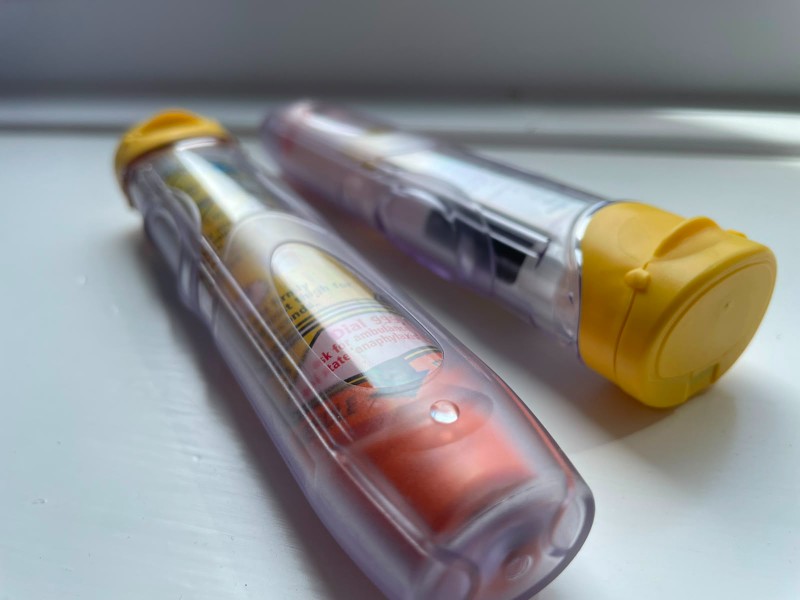
Children who are known to be at risk of anaphylaxis are commonly prescribed adrenaline auto injectors (AAIs) - often referred to as EpiPens - which should be carried with them at all times or be very easily accessible to them.
These contain adrenaline in a pre-loaded injection device, and act as the first line of treatment for serious allergic reactions (anaphylaxis).
This will be detailed in the child's allergy action plan which is held by the school, and pupils should always carry (or have easy access to) two AAIs with them.
A side note on this - keep an eye on their expiration date!
The adrenaline used in these devices degrades over time and may become less effective after the expiry date - and speaking from personal experience here, that expiry date can sneak up on you!
Anaphylaxis UK offers a free alert system in which you can be sent alerts via email or text in advance of the expiry date - you can find it HERE.
SIGNS AND SYMPTOMS
There are 14 main food allergens:
- Celery: Includes stalks, leaves, seeds, and celeriac (often found in soups and stock cubes).
- Cereals containing gluten: Such as wheat, rye, barley, and oats.
- Crustaceans: Examples include prawns, crabs, and lobsters.
- Eggs: Found in baked goods, mayonnaise, and pasta.
- Fish: Often used in Worcestershire sauce, pizza toppings, and some soups.
- Lupin: A flower that is sometimes used in flour or bread mixes.
- Milk: Found in dairy products like butter, cheese, and cream.
- Molluscs: Such as mussels, oysters, squid, and snails.
- Mustard: Can be found in salad dressings, marinades, and sauces.
- Peanuts: A legume often found in snack mixes, satay sauce, and baked goods.
- Sesame: Used on breads, in hummus, and in tahini.
- Soya: A staple in many tofu and Asian dishes, as well as some desserts.
- Sulphur dioxide and sulphites: Often used as preservatives in dried fruits, wine, and meat products.
- Tree nuts: Such as almonds, hazelnuts, walnuts, Brazil nuts, and cashews.
In terms of signs and symptoms, the main thing to remember is ABC:
- AIRWAY - swelling in the throat, tongue or upper airways, hoarse voice, difficulty swallowing
- BREATHING - sudden onset wheezing, breathing difficulty, noisy breathing, persistent cough
- CIRCULATION - dizziness, feeling faint, sudden sleepiness, confusion, pale clammy skin, loss of consciousness or collapse
If you don’t have the ABC symptoms, the reaction is likely to be less serious and is not the same as anaphylaxis.
Mild to moderate symptoms may include:
- a red raised itchy rash (known as hives or urticaria) anywhere on the body
- swelling of the face, lips and/or eyes
- a tingling or itchy feeling in the mouth
- mild throat tightness
- stomach pain, vomiting or diarrhoea
POLICY
You can find the DESC's policy document in full HERE.
And you can find more on anaphylaxis and the management of allergies, including signs and symptoms, via Anaphylaxis UK, HERE.
 Hockey: Fifth straight win for Bacchas in Premier League
 MHK hopes to bring windfarm discussion to next month's Tynwald sitting
 Ferry schedule changes impact Liverpool day trips
 Chris Thomas is a departure from his 'autocratic' predecessors, says infrastructure minister