

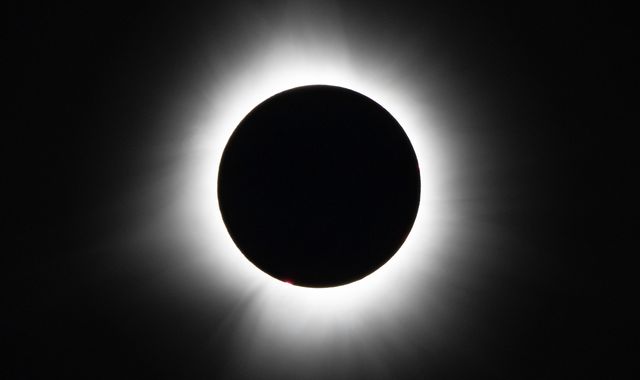
This month, people across Europe will have the chance to see their first solar eclipse in nearly three decades.
The rare celestial event on Wednesday 12 August will see the moon pass directly between the Earth and the sun, briefly plunging people into darkness.
The UK will experience a partial solar eclipse, but it's still set to cover the vast majority of our view of the sun.
But what do we know so far about timings and the weather forecast on the day? Here's everything you need to know.
What time is the eclipse in the UK - and where's the best place to see it?
The UK and Ireland will lose sight of around 90% of the sun - the most since 1999, when a total solar eclipse could be seen from most of Cornwall and Devon.
In London, the maximum coverage of the sun is set to be about 90%, while those in Cornwall will lose sight of around 95% and people in the southwestern tip of Ireland could see almost 98% coverage, according to the Royal Observatory Greenwich.
"First contact" will occur at 6.17pm from London. Timings for other locations in the UK can be seen in the table below:
The moon will move slowly in front - with maximum coverage reached at around 7.12pm in London.
However, unlike conditions experienced during a total eclipse, the sky will not become dark in the UK, according to Royal Museums Greenwich. It will feel more like a cloudy day or close to dusk or dawn.
After the maximum, the moon will slowly move off the sun's disk until the eclipse finishes, at 8.06pm from London.
As the partial solar eclipse will take place as the sun is setting over the UK and Ireland, the sun and moon will become increasingly low on the horizon.
Therefore, watching from a high point with a clear view of the western horizon will allow you to view the whole spectacle.
What will the weather be like in the UK?
It is difficult to forecast conditions, especially for cloud cover, so far in advance, but a long-range forecast from the Met Office, for 13 August to 27 August, says the UK will see "dry and settled conditions" dominating over this period with "high pressure patterns tending to affect the UK".
It says: "This may be interrupted at times by Atlantic frontal systems, especially in the north, or thunderstorms in the south.
"However, overall rainfall amounts will likely be below normal.
"Temperatures will probably be above normal and some spells of hot weather and heatwaves are possible, especially in the south."
According to Sky News meteorologist Dr Christopher England: "As far as the UK is concerned, the South East has statistically the best chance of clear skies, while the North West is more likely to be cloudy."
Read more:
How to view the eclipse safely and more timings
What about across Europe?
The path of totality - where the moon completely covers the sun - begins over Greenland before crossing Iceland and ending in northern Spain and the Balearic Islands.
According to NASA, a small, remote region in northern Russia will experience totality at midday, while for those in Greenland and Iceland it will come in the late afternoon or early evening.
In Spain and the very northwestern tip of Portugal, the sun will not be fully eclipsed until the late evening, shortly before sunset, NASA adds.
Mr England said that in Europe, Spain and Portugal appear to have the best chance for viewings of the eclipse, based on current forecasts, followed by the rest of the Mediterranean, with cloudier skies more likely to the north.
He said that wildfire smoke may also play a factor in some regions.

(c) Sky News 2026: The first solar eclipse in almost 30 years: Where best to view it?
 Most Australian teens still on social media despite landmark ban
 Nirmal Purja: Renowned British Gurkha climber and Netflix star confirmed dead after avalanche
 Tarona Taafaki: Boxer lands Tuvalu's first Commonwealth Games medal without winning a fight
 'Created division': Gianni Infantino abandons FIFA sell-off plan following global backlash