
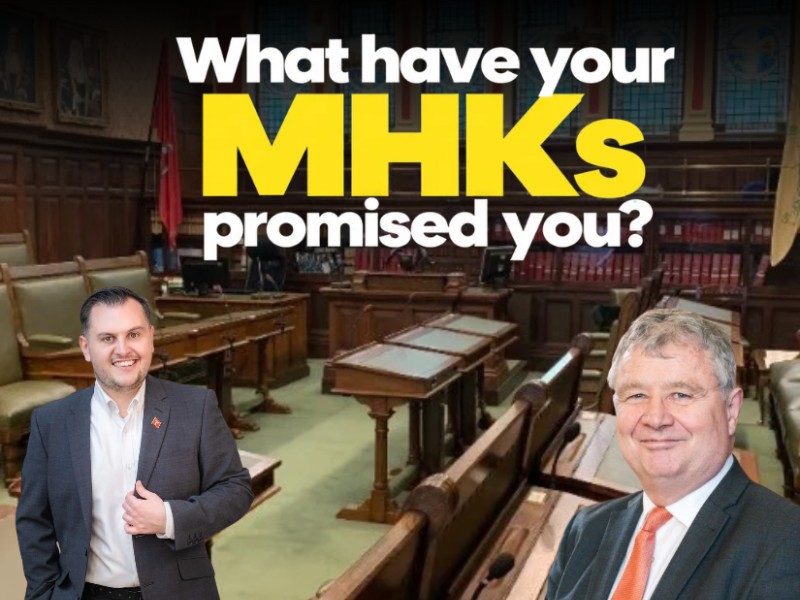
Peter Shimmin and Chris Thomas were Elected
The votes are counted and Douglas Central has returned a blend of fresh ambition and seasoned experience to the House of Keys. Peter Shimmin topped the poll, riding a wave of support for a new generation of leadership and he will be joined in Tynwald by the incumbent Treasury Minister Chris Thomas. Their campaigns offered distinct visions for the constituency and the Isle of Man. Here is a breakdown of where they stand on the critical issues that will define the next five years.
Housing
Both candidates agree that housing is a major problem, but their proposed solutions reflect different priorities and experience.
Mr Shimmin has made housing a central part of his campaign, focusing particularly on the barriers facing younger people and local buyers. His manifesto commits him to a fairer chance for local buyers to own their own home, fewer cliff edges in first-time buyer support schemes, tougher action against rogue landlords and better protection for tenants, clear reporting on commuted sums and the homes they help deliver, better use of brownfield sites, more long-term empty homes brought back into use and close monitoring of Westmoreland Village.
He has also said he would support trialling rent-to-buy schemes for people who struggle to raise a deposit and would push for reforms giving local resident first-time buyers a fairer chance, including ensuring affordable homes are offered first to people with a clear local connection. He has also suggested charging rates on properties left vacant for years without good reason.
Mr Thomas brings his experience as a former chairman of the Housing and Communities Board and is candid that progress was too slow. In his interview, he said he had not been given the budget or power he needed and that the board's budget was largely directed towards emergency housing. He said the board had effectively become a talking shop, while acknowledging that emergency housing provision and housing standards had improved.
His current focus is more strongly on home ownership, arguing for less bureaucratic conveyancing and housing finance, while advocating rent-to-buy and improved shared-equity schemes. He also says Treasury is preparing for what he describes as profound systematic change in how housing is financed and delivered.
Energy
The future of the island's energy supply is a major challenge, and the two candidates have markedly different positions on the pace and direction of the transition.
Mr Thomas, a former Infrastructure Minister, argues that the transition will take much longer than previously envisaged and now advocates a 25-year approach, saying the island is years away from some of the infrastructure needed to move away from fossil fuels. In his interview, he pointed to the potential need for a combined-cycle gas turbine through to around 2040–45 and an interconnector no earlier than 2031–32.
His manifesto calls for applications for gas exploration and production in the previously licensed Block 112/25. He argues that Pulrose gas power station will operate for many years while an alternative is developed, that the electricity network requires investment and that a new electricity interconnector is expensive and years away.
His opposition to the island's offshore wind strategy dates back to his 2014 vote against the Offshore Energy Production Strategy, which he said was taken because there was no sufficiently developed legal framework or Marine Spatial Plan. He continues to argue that offshore wind assumes unsecured UK market access and that the consenting and parallel taxation processes must be completed lawfully and in a way that is publicly acceptable.
Mr Shimmin supports renewable energy and believes the Isle of Man should play its part in tackling climate change, but he has taken a cautious position on the proposed Mooir Vannin offshore wind farm. His manifesto says that, based on the information currently available, the project does not command his support. He has raised concerns about its potential impact on the coastline, wildlife, fishing and marine environment.
Government Reform
Both candidates are calling for significant reform of government, but their approaches differ.
Mr Thomas has made his "smaller, smarter, smoother government" approach a central theme. His plan is based partly on his Treasury experience and includes priority-based budgeting, moving away from rolling departmental budgets towards funding linked to intended results.
He says many millions of pounds could be saved through greater efficiency, including recruitment controls, removing redundant roles, better management of public property, procurement savings and reduced reliance on generalised consultancy. He has spoken of hundreds of potentially redundant roles and, in the interview, said the previous administration had been targeting £10 million a year in savings.
He also advocates a "digital first, not digital only" approach, retaining community hubs alongside improved online services, and calls for greater coordination between government departments and public bodies.
Mr Shimmin's approach is less about a specific structural programme and more about changing the way government operates. He has criticised duplication, management structures and what he sees as a lack of focus on value. He argues that government needs to spend public money better while creating the conditions for economic growth, and says politicians need to set priorities and hold the public service accountable for delivering them.
He also places emphasis on being a visible, responsive and connected constituency MHK, using modern communication methods and maintaining a strong focus on constituency issues.
The Economy
The candidates' different fiscal philosophies are particularly apparent on the economy.
Mr Thomas points to his 2026 Budget as evidence of his approach, highlighting the largest-ever increase in the personal tax allowance and arguing that putting more money into people's pockets will stimulate spending and investment. He describes this as "trickle-up economics" and says the aim is to create confidence to secure jobs, increase private investment, export and grow the economy.
His manifesto also calls for the island to use the outcome of the MONEYVAL evaluation to support economic growth and finance healthcare and other public services. He advocates measures to support financial and professional services, upskilling, export-focused entrepreneurs, simpler licensing and reduced regulation.
Mr Shimmin frames economic growth as central to the island's ability to fund public services. In his interview, he cited a 7.4% contraction in the economy and the loss of 1,000 jobs, particularly in the e-gaming sector, while arguing that the island needs more proportionate regulation and better communication between government and the private sector.
His wider economic approach is based on two things: reducing unnecessary public spending and growing the economy so that successful businesses create employment and generate more tax revenue. He also emphasises the connection between education, skills and employers.
Education
Both candidates see education as important to the island's future prosperity, but Mr Shimmin places particular emphasis on vocational and technical pathways.
His manifesto calls for academic, vocational, technical and creative routes to be given equal value. He wants earlier intervention for learners with additional needs, improved apprenticeships, stronger links between education, UCM, employers and government, extended student-loan cancellation for shortage professions and greater support for families through childcare.
He has also highlighted the difficulties businesses can face in supporting apprentices and argues that the risk should not fall disproportionately on employers.
Mr Thomas's wider economic strategy places significant emphasis on upskilling local people of all ages and connecting skills provision with economic needs. His manifesto also identifies education facilities as part of the island's strategic infrastructure requirements.
In Douglas Central, he has pointed specifically to progress on Henry Bloom Noble and the commitment to replace Scoill yn Jubilee, while arguing for greater investment in highways, pavements, crossings and community infrastructure.
Steam Packet and Connectivity
Both candidates agree that reliable sea and air links are essential to the island, although they focus on different aspects of the problem.
Mr Thomas is highly critical of the missed opportunity to reset the 25-year Sea Services Agreement in 2024/25 and is calling for an urgent call for evidence on sea and air services. He wants attention focused on issues including Steam Packet fares and freight charges, sailing schedules, the fleet, harbour infrastructure and the replacement of the Manannan.
On air services, he advocates exploring a strategic partnership with a locally based airline and says the airport requires more than £6 million in subsidy and investment, with priorities including governance and regulation, security and baggage, air traffic control and development around the airport perimeter.
Mr Shimmin focuses more heavily on the passenger experience. His manifesto calls for the next Sea Services Agreement to include clear standards for dealing with disruption, better coordination between operators and government, exploration of resident ferry discounts or a customer loyalty scheme, and the establishment of a Passenger and Freight Council.
Local Government Reform
Mr Thomas explicitly supports local government reform, stating in his manifesto that "now is the time for local government reform". His wider approach is to improve coordination between central government, statutory boards and regional bodies and to make government services work more effectively across organisational boundaries.
Mr Shimmin does not set out an equivalent detailed programme for local government reform in the manifesto and interview supplied for this comparison. His manifesto does, however, include commitments affecting Douglas directly, including improved maintenance of roads and public spaces, revitalising the city centre and releasing Government-owned city-centre land at reduced cost to help create a more vibrant central hub.
 Damaged crossings to be replaced
 MLC reiterates calls for milestone payments for new parents
 Aldi or Lidl on the way?
 Exhibition marking 10 years of Biosphere status opens at Museum