

Independent inspector to advise minister after detailed debate over illuminated sculpture beside Tynwald Hill
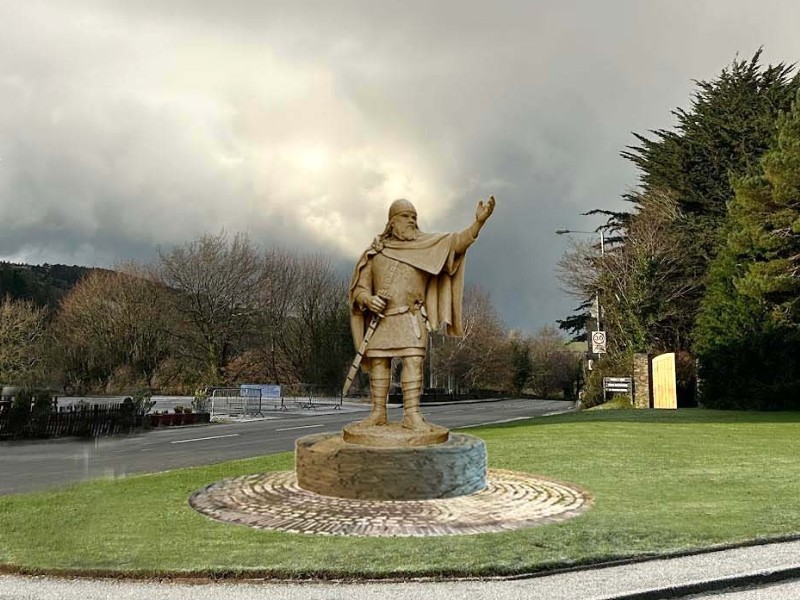
An appeal against plans to install an illuminated sculpture of King Orry beside Tynwald Hill has been heard, with detailed arguments focusing on heritage impact, archaeology and planning policy.
The appeal has been brought by Manx National Heritage (MNH) after the Planning Committee approved the proposal, despite the case officer having initially recommended refusal.
The scheme would see a statue, just under three metres tall and 1.8 metres wide, placed on a verge adjacent to Tynwald Hill in St John’s. The figure - described as Godred Crovan, also known as King Orry - would stand with a sword and shield, mounted on a plinth inscribed in Manx Gaelic, English and runes.
The project would be privately funded with no access to taxpayer money.
The hearing was led by independent inspector Frances Mahoney, who confirmed she had visited the site twice, including the chapel, processional walk and surrounding grounds. She will now prepare a report with a recommendation for the Environment, Food and Agriculture Minister Clare Barber, who will make the final decision.
Who is behind the proposal?
The application has been submitted in the name of Laurence Skelly - also the President of Tynwald - who told the inquiry the idea stemmed from a long-held desire to promote the origins of Tynwald as “the oldest continuous parliament in the world”.
He stressed he was acting in a personal capacity, not on behalf of Tynwald itself, and that no public funds would be used. He said the intention was educational - to highlight the Island’s Norse heritage and provide visitors with greater historical context.
Historian Charles Guard, speaking in support, said the statue was intended to symbolise Tynwald’s Viking origins. He acknowledged there is no confirmed likeness of Godred Crovan, describing the design as an artistic interpretation informed by historical advice.
Heritage and setting
Representing Manx National Heritage, Andrew Johnson - an archaeologist and conservation specialist - argued the proposal would harm the setting of the site.
Tynwald Hill, along with the chapel and processional pathway, are registered buildings. MNH believes the area’s significance lies not only in those built elements, but in its openness - a largely uninterrupted landscape since the 1840s, defined by the Hill, the chapel and the wider fair field.
Mr Johnson described the site as “fundamentally open and restful” and said the statue would represent a substantial visual intrusion. He noted that at nearly the same height as the Hill itself, it could “distract” from the focus of the ceremonial space.
Planning officers from the Department of Environment, Food and Agriculture acknowledged differing professional views. The case officer had considered the statue likely to detract from the site’s historic value. However, the Planning Committee concluded it would enhance public appreciation and make a positive contribution to understanding Tynwald’s origins.
The inspector also heard discussion about the site’s status as a previously proposed conservation area. DEFA officers confirmed it has never been formally designated, meaning limited weight could be given to that status in planning terms.
Historical accuracy
Another point of contention was whether the statue accurately represents a Viking figure.
MNH argued the design was too vague to be considered a clear historical representation of Godred Crovan or the Viking period associated with the Island’s parliamentary origins.
Supporters accepted there was artistic licence involved but maintained efforts had been made to ground the design in historical context.
Archaeological concerns
A significant part of the hearing focused on archaeology.
A geophysical survey carried out in 2010 had been submitted as supporting evidence. The applicant described it as sufficient and said it revealed no anomalies.
However, MNH argued the survey did not cover the precise footprint of the proposed statue and raised concerns about the age of the equipment used. It called for a new survey and archaeological evaluation before any development proceeds.
Mr Johnson referenced previous discoveries of human remains during earlier works in the area and described the wider site as archaeologically sensitive. He warned that without full evaluation, there was a risk of disturbing significant remains - potentially including Viking burials.
The inspector questioned whether further investigation could be secured through planning conditions rather than requiring refusal at this stage. MNH maintained that detailed assessment should be undertaken upfront to properly understand the risks.
DEFA officers described the level of information provided as proportionate for a single artwork installation, distinguishing it from large-scale development.
Public art and planning weight
Supporters argued the planning system encourages public art and that the statue would provide educational and cultural benefit, particularly given its proximity to Culture Vannin.
The inquiry also examined a so-called “fallback position” - whether a government department could install such a structure without planning permission. DEFA said there was some weight in that argument because the land is publicly owned and the relevant body had not objected. However, the inspector indicated that weight depends on how likely that alternative scenario is in practice.
What happens next?
Mrs Mahoney will now consider the evidence presented by both sides and prepare a report with a recommendation.
That recommendation will be submitted to Environment, Food and Agriculture Minister Clare Barber, who will make the final decision on whether the illuminated King Orry sculpture can proceed.
 Fuel supplies to the Island remain 'reliable'
 Horse tram business case misses Tynwald deadline
 Government joins Sunflower Hidden Disabilities scheme
 Peace Plaque installed in Hutchinson Square